
Event Description
The forum, titled “The Dual Climate and Energy Emergency: Experiences from Taiwan and the UK,” will bring together researchers, civil society representatives, and policy stakeholders to discuss how Taiwan and the UK are responding to the intertwined challenges of climate change, energy security, and the urgent need for an accelerated energy transition. Through comparative exchange, the forum will explore how societies can move beyond short-term emergency responses and build more secure, resilient, and low-carbon futures.
For Taiwanese communities in the UK, the forum offers a timely opportunity to engage with Taiwan’s climate and energy challenges from an international perspective, and to consider how Taiwan’s experience connects with wider debates on energy security, national resilience, and climate action. For UK-based climate and energy experts, the forum provides a comparative case of an advanced industrial economy facing high energy-import dependence, power-sector transition pressures, industrial decarbonisation challenges, and rising climate risks. It is designed as a space for mutual learning among people working on climate policy, energy transition, civil society advocacy, public health, urban resilience, local climate action, and environmental governance.
The forum is convened against the backdrop of two converging risks: an escalating energy-supply crisis and the prospect of intensified summer heat associated with a potential strong El Niño event. In Taiwan, energy resilience has become a critical component of national security debates. Yet under the impact of one of the most severe energy-supply crises in recent history, Taiwan’s policy responses have largely focused on securing alternative LNG supplies, subsidising oil and electricity prices, and restarting retired coal-fired power plants. These measures may address short-term supply and price pressures, but they have not yet translated into a more accelerated transition away from fossil fuel dependence.
The UK experience offers a useful point of comparison. Alongside targeted consumer support measures to shield households and businesses from rising energy costs, the UK has also pursued structural reforms, including accelerating home energy efficiency upgrades, supporting electrification through EVs and heat pumps, expanding solar and wind deployment, and reducing the link between electricity prices and gas markets. By placing Taiwan and the UK side by side, the forum will create space to exchange policy observations on how energy crises can be addressed while strengthening long-term energy resilience, affordability, and the transition toward cleaner and more secure energy systems.
At the same time, Taiwan is facing rising heat risks that require more concrete, community-based, and equitable adaptation measures. Heat adaptation is not only about issuing warnings, opening cooling shelters, or providing short-term subsidies; it also requires testing whether health services, transport systems, utilities, schools, care networks, workplaces, and local communities can function under prolonged and extreme heat. In this context, TCAN will share observations on Taiwan’s recent heat adaptation policy discussions, including cross-departmental governance, local implementation, vulnerable groups, public health preparedness, and labour protection. The session will also draw on UK experience, including recent work on neighbourhood heat adaptation in Glasgow with community organisations and residents, to explore how resilience, equity, and justice can support more effective community-level responses.
This London forum is connected to the inaugural Taiwan Climate Action Week, held from 20 June to 5 July 2026. Rather than being a separate event, the forum serves as an international dialogue platform of Taiwan Climate Action Week, bringing Taiwan’s domestic climate debates into conversation with UK and international experiences during London Climate Action Week. By convening this discussion in London, TCAN hopes to open up a transnational dialogue on climate action, energy transition, adaptation, and social resilience.
Taiwan Climate Action Week builds on the collective action demonstrated in last November’s “March for Climate — Building a Resilient Taiwan,” organised by TCAN and partner organisations. The march brought thousands of people onto the streets to call for stronger climate commitments and showed how climate issues are connected to everyday life, national resilience, and social transformation.
TCAN is a civil society network in Taiwan working to accelerate climate action through policy research, public advocacy, cross-sector dialogue, and local climate action. Its work focuses on energy transition, carbon pricing, industrial transformation, and local climate action. Through this forum, TCAN seeks to connect Taiwan’s climate governance challenges with wider international debates and contribute to deeper Taiwan-UK exchange on climate and energy transition.
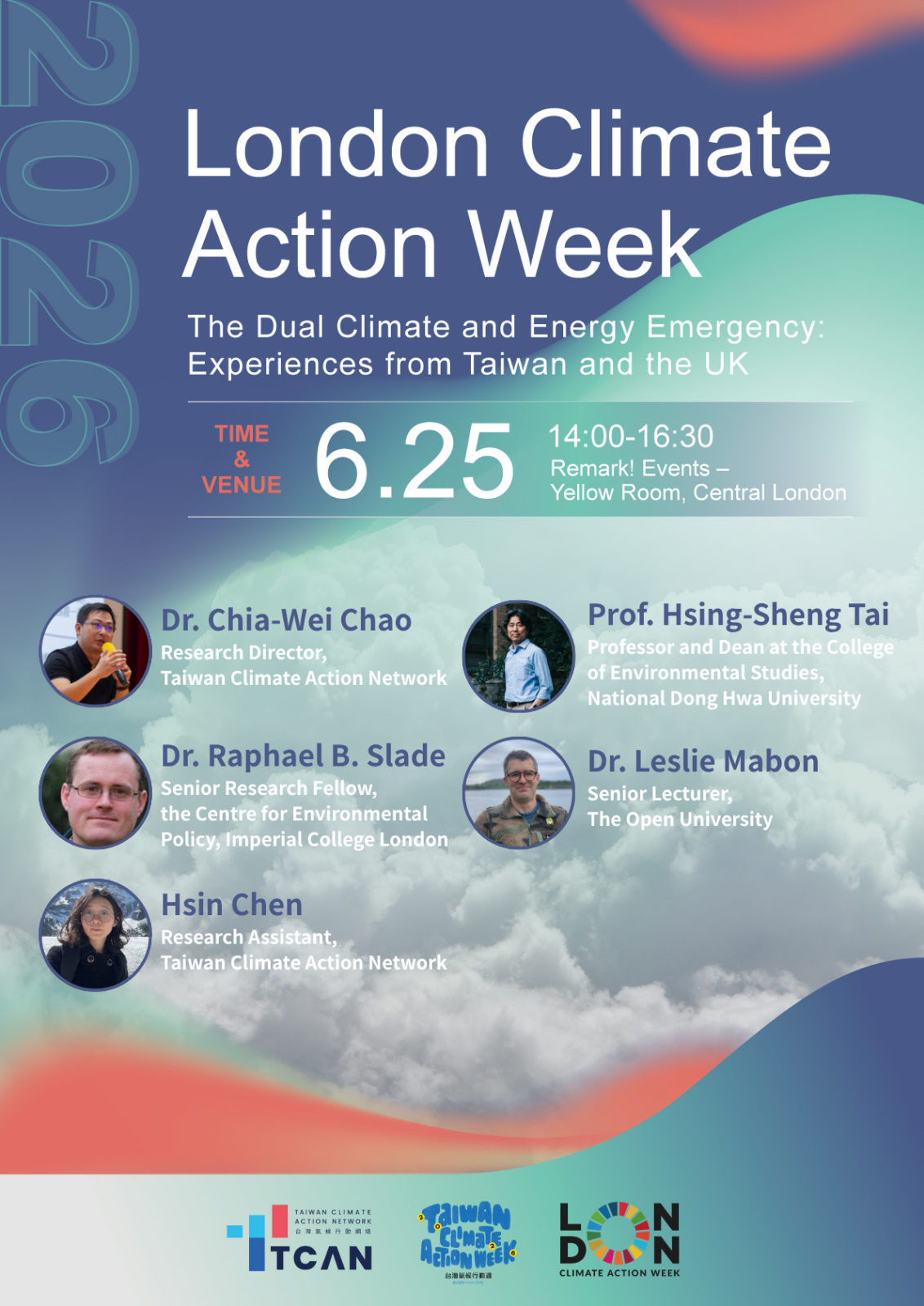
Date: 25 June : 14:00~ 16:30
Venue: Remark! Events – Yellow Room, Central London
Registration : https://luma.com/mwsf5wsx
Schedule
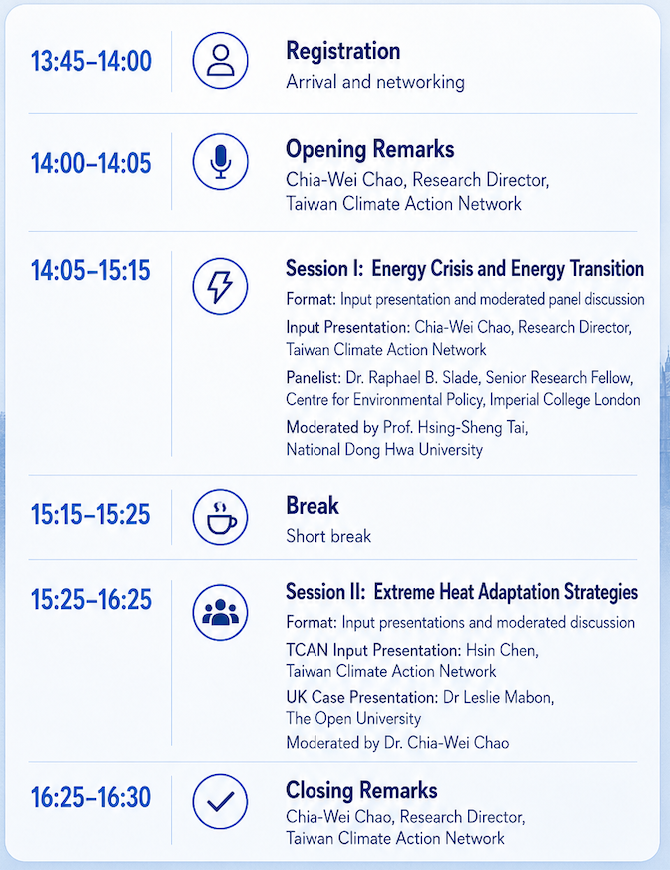
Session I: Energy Crisis and Energy Transition
This session will examine how Taiwan, the UK, and the wider international community are responding to the dual pressures of energy security and climate action. The discussion will focus on power-sector decarbonisation, fossil fuel dependence, energy affordability, and the policy choices governments face during energy-supply crises. By comparing Taiwan’s current reliance on short-term supply and price measures with the UK’s mix of consumer support and structural transition policies, the session will explore how energy resilience can be strengthened without delaying the transition away from fossil fuels.
Session II: Extreme Heat Adaptation Strategies
This session will examine how governments, cities, communities, and civil society can respond to rising heat risks through stronger preparedness and more equitable adaptation. TCAN will share observations on Taiwan’s recent heat adaptation policies, including cross-departmental governance, local implementation, vulnerable groups, public health preparedness, and labour protection. UK speakers will contribute comparative insights on neighbourhood and community-based heat adaptation, including how resilience, equity, and justice can inform practical responses to prolonged and extreme heat.
Moderators and Speakers
Prof. Hsing-Sheng Tai
Prof. Hsing-Sheng Tai is Professor and Dean at the College of Environmental Studies, National Dong Hwa University, and Principal Investigator of the Taiwan Net-Zero Social Science Research Project. Trained as an economist with a PhD from Heidelberg University, his work spans sustainable development, natural resource economics, commons governance, community conservation, and conservation-development relations. He brings long-standing expertise in environmental governance and social science perspectives on net-zero transition.
Dr. Raphael B. Slade
Dr. Raphael B. Slade is Senior Research Fellow at the Centre for Environmental Policy, Imperial College London. His research focuses on energy systems analysis and the role of energy policy in supporting technological innovation. His recent work examines the commercial and environmental prospects of biomass-derived transport fuels. With training in bioenergy, environmental technology, and chemistry, he brings interdisciplinary expertise to discussions on energy transition, innovation, and sustainable energy systems.
Dr. Leslie Mabon
Dr. Leslie Mabon is Senior Lecturer in Environmental Systems at The Open University’s School of Engineering and Innovation. With a PhD in Geography, his research asks whose knowledge counts in environmental management and policy. He works on climate adaptation governance, equity and justice in risk reduction, and nature-based approaches to urban heat resilience, including collaborations on climate-resilient neighbourhoods and adaptation in Taiwan.
Dr. Chia-Wei Chao
Dr. Chia-Wei Chao is Research Director of Taiwan Climate Action Network. He holds a PhD in Environmental Engineering from National Taiwan University and works on sustainability transitions and industrial ecology. Since 2007, he has supported evidence-based climate and energy policy advocacy for environmental NGOs. At TCAN, he leads research on net-zero policy action and teaches courses on pathways toward net zero in Taiwan.
Hsin Chen
Hsin Chen is a Research Assistant at Taiwan Climate Action Network and a student in the Department of Atmospheric Sciences at National Taiwan University. Her work focuses on climate change adaptation, especially water resources, high temperatures, and local adaptation. She has also been active in youth-led climate action, helping raise public awareness and promote sustainable solutions among young people in Taiwan.

