Event Recap | LCAW 2026 The Dual Climate and Energy Emergency: Experiences from Taiwan and the UK
2026-07-16
Chia-Wei Chao(Research Director)、Hsin Chen(Research Assistant)、Jui-Ching Chang(Research Specialist (Departed Aug 2025))
When heat and geopolitics collide: Taiwan and the UK confront a double emergency
As London endured record-breaking temperatures, a forum held during London Climate Action Week offered an immediate reminder of the crisis under discussion. Trains were disrupted, buildings overheated and several events were moved online or cancelled. Climate adaptation was no longer an abstract policy debate; it was unfolding outside the meeting room.
Taiwan Climate Action Network (TCAN) convened “The Dual Climate and Energy Emergency: Experiences from Taiwan and the UK” on 25 June, bringing together researchers, campaigners and policy specialists to examine two increasingly connected threats: geopolitical disruption to energy supplies and the mounting consequences of extreme heat.
It was the first formal London Climate Action Week event organised by a Taiwanese environmental advocacy group. The event formed part of LCAW’s largest edition to date, which attracted more than 100,000 participants from over 100 countries and included more than 1,300 events across London.
The TCAN forum itself attracted 37 registered participants from government, finance, academia, consultancy and civil society. They included representatives from the UK Foreign, Commonwealth and Development Office, Brazil’s Ministry of the Environment and Climate Change, the universities of Oxford and Edinburgh, Global Witness, the Climate Group, the Institutional Investors Group on Climate Change, the World Benchmarking Alliance, IEEFA, ERM, EIA International, Urgewald and Norton Rose Fulbright.
Can an energy crisis become a window for transition?
The first session was chaired by Hsing-Sheng Tai, Dean of the College of Environmental Studies and Oceanography at National Dong Hwa University.
Opening the discussion, Chia-Wei Chao, Research Director of TCAN, warned against reducing Taiwan’s energy-security debate to a single technological choice. Rising electricity demand from artificial intelligence and semiconductor manufacturing had strengthened calls to treat nuclear power as the principal answer to both power shortages and national security concerns. Chao argued that this framing risked deepening Taiwan’s existing “nuclear myth” while obscuring the wider changes required to build a resilient energy system.
Taiwan imports about 95% of its energy, leaving it exposed to disrupted shipping routes, price volatility and geopolitical pressure. Yet Chao said public debate often focused narrowly on how long existing fuel stocks would last, without considering how electricity demand would change during an emergency.
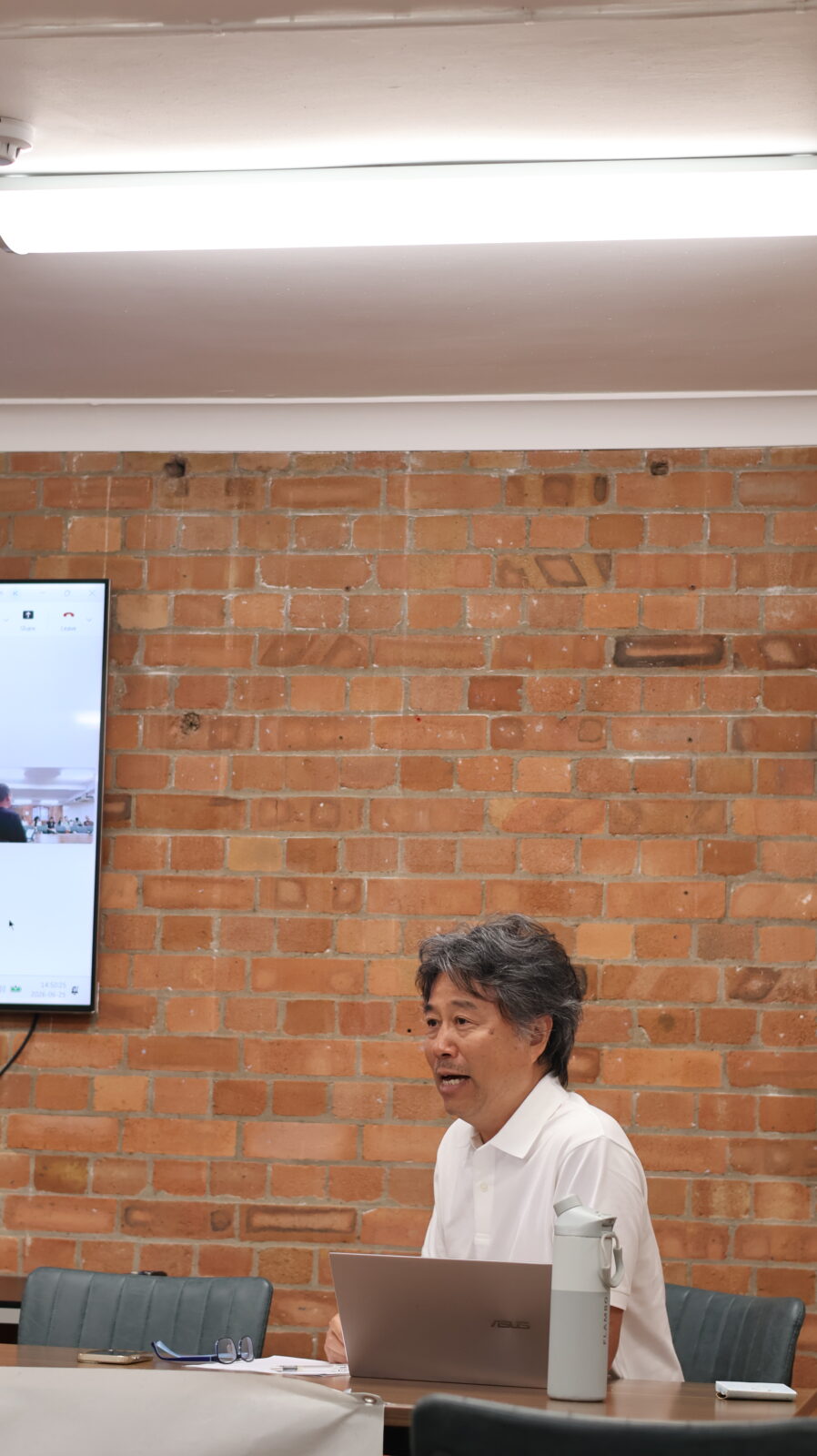
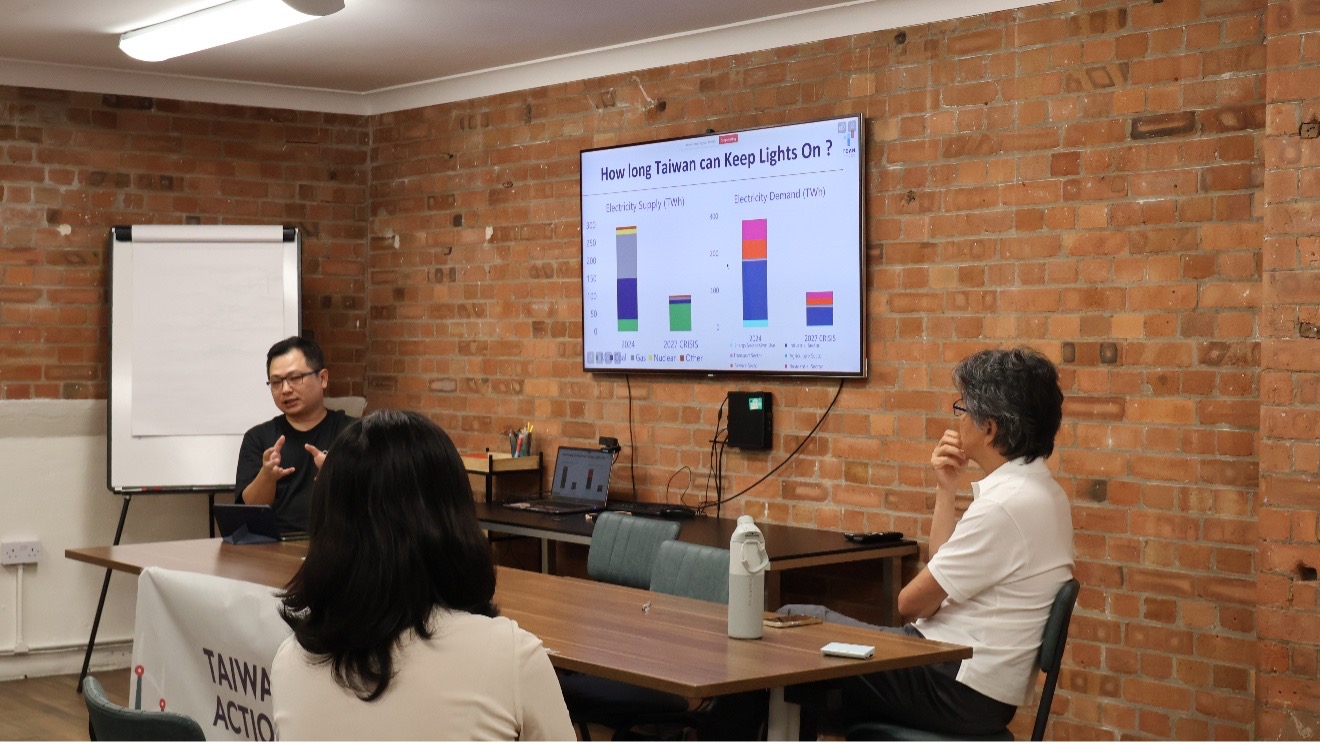
Chia-Wei Chao, Research Director of TCAN, outlines Taiwan’s current energy security challenges.
TCAN’s scenario analysis suggests that, if Taiwan meets its renewable-energy and climate targets, domestic generation and existing coal and gas stocks could maintain about 30% of normal electricity output during a severe interruption to imported fuels. Demand could simultaneously fall to around 40% of normal levels as shopping centres, entertainment venues and other non-essential activities shut down.
The conclusion was not that Taiwan was already secure, but that resilience could not be achieved simply by buying more fossil fuels abroad. Chao called for greater energy efficiency, faster renewable deployment and targeted support for household and community solar. Increasing the domestic share of energy could reduce import dependence from about 95% to 74%, making renewables a national-security asset rather than merely a climate policy.
Raphael Slade, Senior Research Fellow at the Centre for Environmental Policy in Imperial College London’s Faculty of Natural Sciences, joined remotely after the heat disrupted his rail journey.
Drawing on his experience with the IPCC’s mitigation work, Slade said many global decarbonisation pathways had been developed before Russia’s invasion of Ukraine and assumed relatively stable trade, technological exchange and international cooperation. Those assumptions could no longer be taken for granted.
Energy security, he argued, encompassed far more than fuel stocks. It included electricity interconnectors, pipelines, digital systems, critical minerals and the capacity of transport and energy infrastructure to withstand extreme weather.
Countries should therefore manage energy as a portfolio, avoiding excessive dependence on one technology, supplier or route. Ukraine’s experience had shown that decentralised systems were harder to disable than a small number of large power stations. Although wind and solar remained variable, improved grids, storage and demand management could address this challenge.
Raphael Slade, Senior Research Fellow at the Centre for Environmental Policy, Imperial College London, reflects on his experience contributing to IPCC Working Group III.
A cleaner system, but not a risk-free one
Questions from the audience turned to the vulnerabilities embedded in the energy transition itself.
China dominates the manufacture of batteries, heat pumps and solar equipment, as well as the processing of several critical minerals. Participants asked whether dependence on Chinese inverters, grid-control systems and offshore wind technologies could create cybersecurity risks or expose countries to economic coercion.
The speakers acknowledged the need for tighter equipment controls and more diversified supply chains. But Chao said one of Taiwan’s most immediate barriers was political rather than technological: declining public acceptance of solar development.
Large companies, particularly semiconductor and technology manufacturers, increasingly need renewable electricity to meet international commitments and remain competitive. Yet many remain silent when renewable projects face misinformation or local opposition. The panel argued that these companies should not act only as green-electricity buyers; they should also explain publicly why renewable development matters for competitiveness and energy security.
Participants also questioned whether Taiwan’s planned reliance on natural gas and carbon capture, utilisation and storage could create another form of fossil-fuel lock-in. Slade said experience in Britain and Japan showed a persistent gulf between CCS ambitions and actual deployment. Projects had been costly, slow and difficult to operate at scale.
Carbon capture could have a limited role in hard-to-abate sectors, the panel concluded, but it should not become an excuse for delaying efficiency, demand reduction or renewable-energy expansion. Distributed renewables could instead reduce reliance on imported fuels, single shipping routes and individual large facilities, while rooftop solar and community energy could strengthen local resilience.
An audience member asks how Taiwan can respond to the rapid growth in electricity demand driven by artificial intelligence.
From heat warnings to heat governance
The second session, moderated by Chao, turned to extreme-heat adaptation.
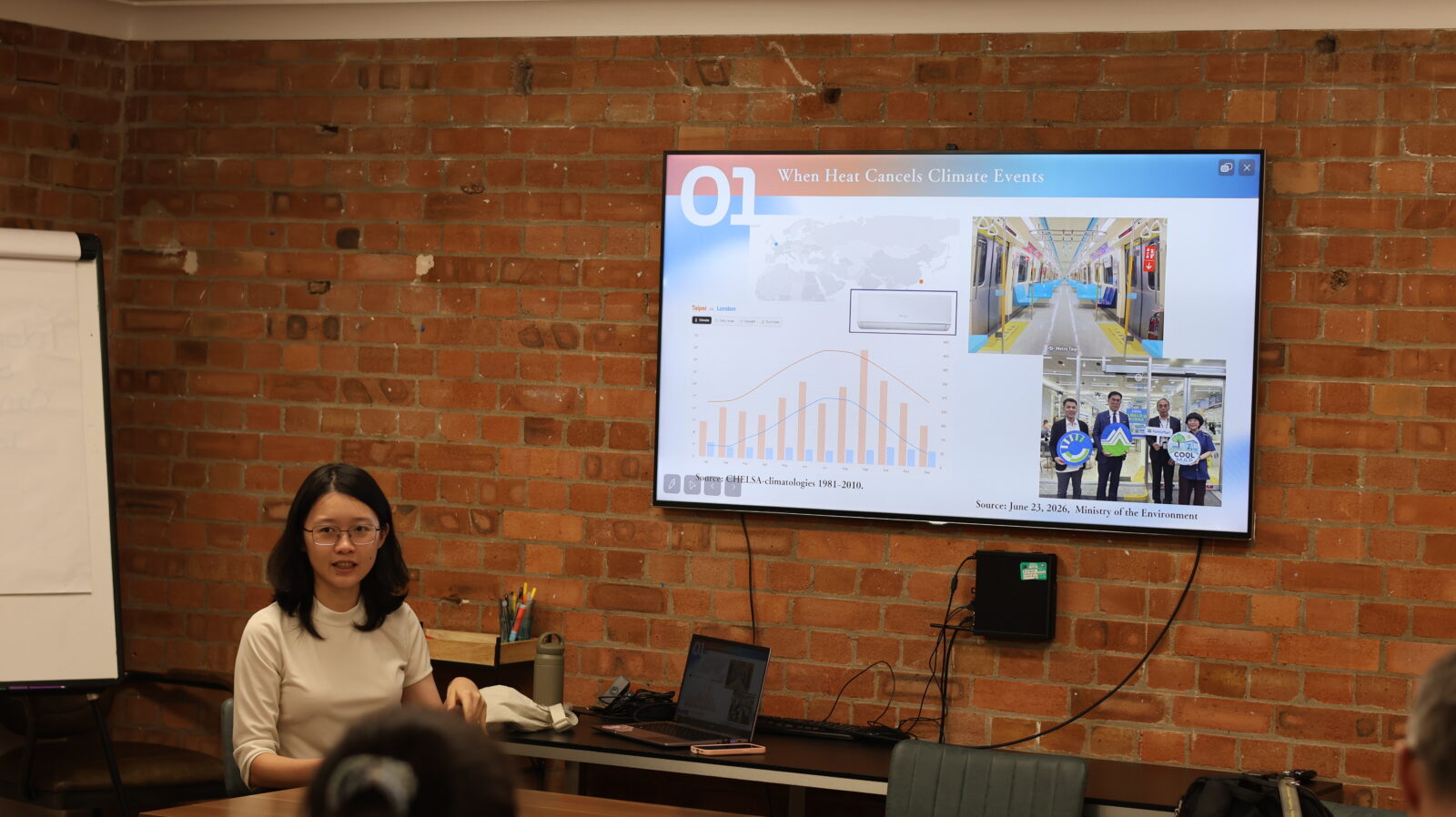
Hsin Chen, a researcher at TCAN, said Taiwan already had heat-health alerts, labour guidance, cooling maps and urban-greening programmes. What it lacked was a coherent system for identifying who was most vulnerable, where they were exposed and whether public measures were actually reducing harm.
Hsin Chen discusses gaps in Taiwan’s policies and implementation on extreme-heat adaptation.
Delivery riders illustrated the gap. They work for long periods outdoors, yet their constantly changing workplaces make them difficult to protect through conventional labour inspections. Homeless people may be unable to reach or use designated cooling spaces because of distance, costs or social barriers. Residents of older buildings may have air conditioning but continue to live in homes that retain heat.
Chen’s review found that heat-related measures made up only a small proportion of Taiwan’s national adaptation programme. Many initiatives had simply been carried over from previous plans, often without additional funding, clear institutional responsibility or measurable outcomes.
Instead of counting the number of warnings issued, workshops organised or air conditioners installed, Chen said governments should assess whether vulnerable residents were actually reached, whether high-risk districts had accessible cooling facilities and whether buildings and public spaces were becoming safer.
Shade is also about power
Leslie Mabon, Senior Lecturer in Environmental Systems in the School of Engineering and Innovation at the Open University, presented research comparing heat resilience in Glasgow and Taipei.
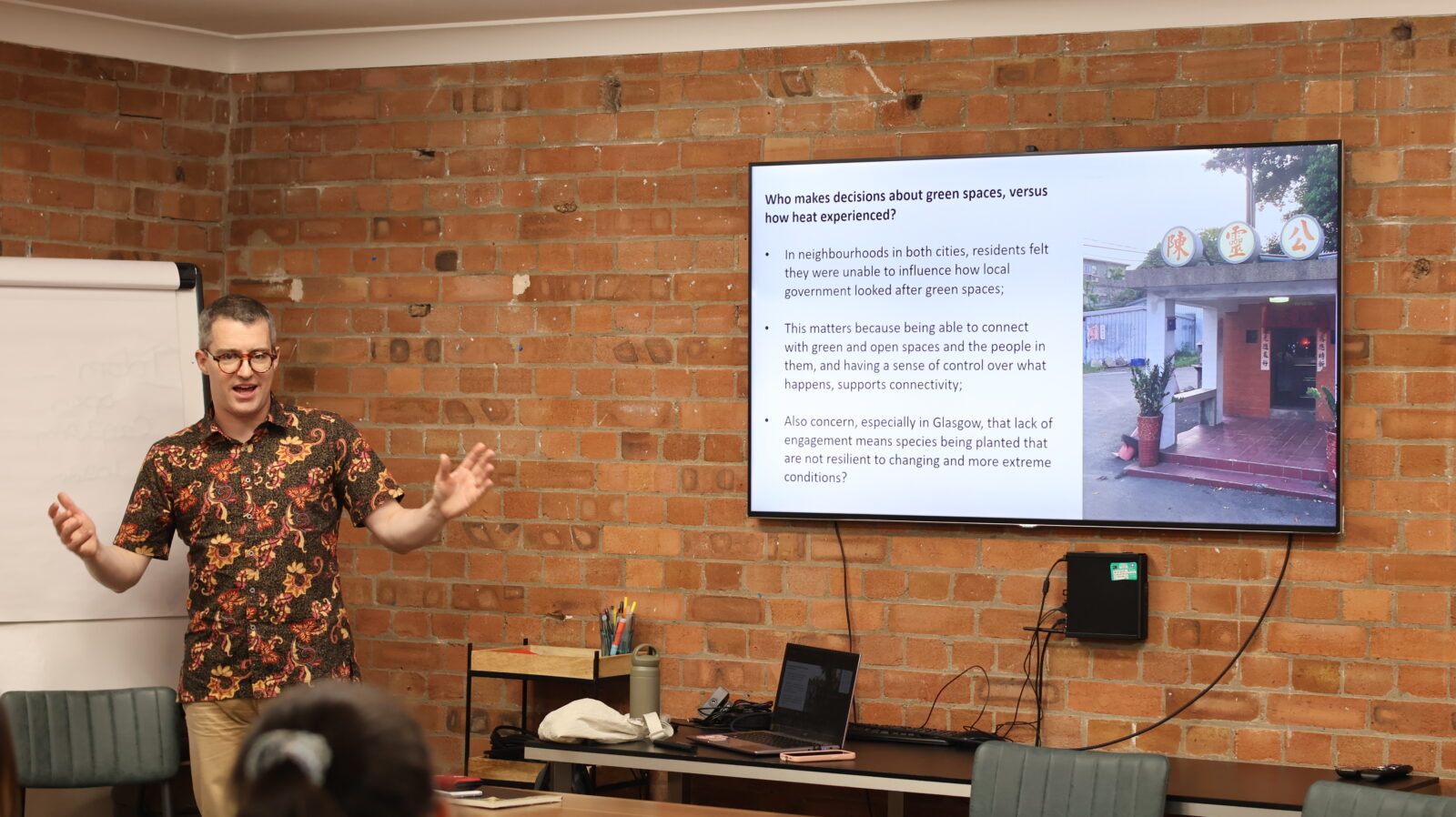
Dr. Mabon presents community-based approaches to extreme-heat adaptation in Glasgow.
His central point was that urban greening could not be reduced to tree numbers or hectares of green space. Trees and shade had to be placed where heat exposure and social vulnerability were greatest, while the species selected needed to survive future climate conditions.
Research in Glasgow and Taipei’s Shezi Island found close links between income, deprivation, heat exposure and access to green space. In both cities, residents in less affluent neighbourhoods often had to travel considerable distances to find shade or a cool indoor space. The journey itself could involve walking along exposed streets.
Heat resilience was therefore not simply a question of individual behaviour. It was shaped by land ownership, planning authority, maintenance budgets and whether residents had any meaningful influence over their neighbourhoods.
Audience questions returned to the problem of government coordination. Heat adaptation is often assigned to environmental departments, even though effective responses require health, social welfare, transport, emergency services, energy and urban-planning agencies to work together. Transport, electricity and cooling also cannot be planned separately: a cooling centre is of little use if a power failure shuts it down, or if disrupted transport prevents vulnerable people from reaching it.
An audience member asks how indicators should be developed to assess the effectiveness of climate adaptation policies.
The forum’s broader conclusion was that neither emergency could be addressed through isolated short-term measures. Energy resilience requires efficiency, diversified supply and distributed renewable power. Heat adaptation requires accessible cooling, building upgrades, risk-based investment and community participation. The real test is not simply whether societies can withstand the next crisis, but whether they use it to build systems that are more secure, more decentralised and fairer.