March 30, Taipei- On the third anniversary of the announcement of the Climate Change Response Act, the Taiwan Climate Action Network (TCAN) and the Environmental Rights Foundation urged the Taiwanese authorities to put forward a more comprehensive policy framework and to enhance the use of carbon fee revenues to accelerate emissions reduction in heavy industry, while strengthening social welfare.
The suggestions were made during a symposium held on March 25th, with representatives from the Climate Change Administration, Ministry of Environment and leading academics participating in the discussion. Speakers included Chung-En Liu (Professor, Department of Sociology, National Taiwan University), Daigee Shaw (Adjunct Research Fellow, Institute of Economics, Academia Sinica), Chun-Yuan Lin (Associate Professor, College of Law, National Taiwan University), and Wen-Chen Shih (Professor, Department of International Business, National Chengchi University).
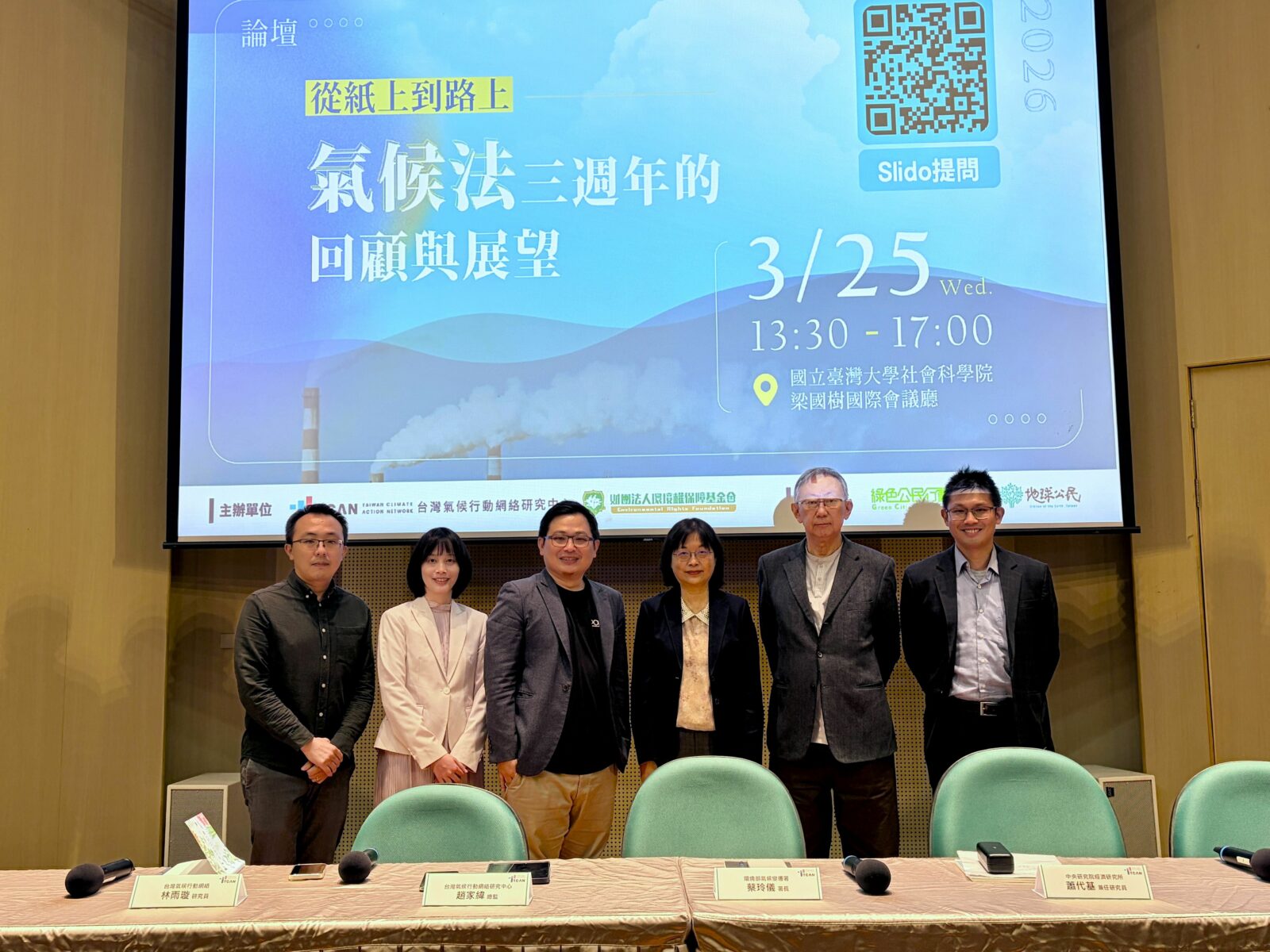
A group photo of the speakers for the first session, “Strengthening Effective Carbon Pricing.” From left to right: Director Aerys Tang of ERF, Researcher Yu-Hsuan Lin of TCAN, Research Director Chia-Wei Chao of TCAN, Director-General Ling-Yi Tsai of the Climate Change Administration, Dr. Daigee Shaw, and Professor Chung-En Liu.
Taiwan has set a nationally determined contribution (NDC) target of 26 to 30 percent by 2030, and 36 percent to 40 percent by 2035. According to the UN Environment Programme’s Emissions Gap report, Taiwan’s carbon emissions continued to decrease over the past three years and declined by more than 2 percent compared to 2023.
To achieve its emission reduction goal, the parliament passed the Climate Change Response Act in 2022, establishing the legal basis for carbon pricing and greenhouse gas management. After three years of implementation, Taiwan’s carbon fee system has seen 430 companies apply for voluntary reduction plans. According to Climate Change Administration Director-General Ling-Yi Tsai, these initiatives are expected to deliver approximately 47.45 million tonnes of CO₂ reductions by 2030. With the carbon price set at NT$300 (with preferential rate NTD50 to NT$100) per tonne of CO₂, the system is projected to generate around NT$4.5 billion in revenue this year.
Looking ahead to the 2035 emissions reduction targets, Tsai also mentioned the government plans to explore a gradual transition from the carbon fee system to an Emissions Trading System (ETS) to strengthen overall mitigation efforts, with a pilot program tentatively scheduled for 2027 or 2028.
Against this backdrop, as the real-world effectiveness of ETS in reducing emissions faces growing scrutiny in Asia, NGOs in Taiwan are paying close attention to key design issues—particularly the alignment between Taiwan’s ETS cap and its national NDC, as well as concerns over overly generous free allocation.
“If Taiwan is to implement an ETS, it must set an ambitious emissions cap and adopt stringent benchmarks for allowance allocation,” said Yu-Shiuan Lin, researcher at TCAN. “Given the steep learning curve associated with ETS, the government should prioritize introducing a carbon tax as a more stable and feasible approach.”
Tai-Chi Hsiao also suggested the government should continue advancing toward a carbon tax system, allocating revenues to carbon removal and direct public rebates in order to balance equity considerations with emissions reduction goals.
Amid growing attention to how NTD 4.5 billion in carbon fee revenues will be used, Environmental Rights Foundation climate change and just transition officer Lin-Hsiang Tang suggested using this revenues to provide discounts for green consumption, in ways similar to programs such as TPASS or cultural vouchers. “We must ensure that people feel that carbon pricing helps improve their daily lives. This will be key to building the social support needed to raise the carbon fee to between NT$1,200 and NT$1,800 per tonne,” he said.
He added that Taiwan should also draw on the European Union’s experience by allocating a portion of carbon pricing revenues to clean energy and decarbonization investments, prioritizing hard-to-abate sectors such as steel, petrochemicals, and cement, as well as forward-looking low-carbon infrastructure and technological innovation.
NGOs therefore called on the government to adopt a more comprehensive and coherent climate strategy, including the implementation of performance standards under the legal framework of the Climate Change Response Act and ensuring the proper use of funds for emissions reduction and climate adaptation, in pursuit of both environmental effectiveness and social equity as Taiwan moves toward its long-term climate goals.

A group photo of the speakers for “Deepening Climate Governance.” From left to right: Research Director Chia-Wei Chao of TCAN, Professor Chun-Yuan Lin, Attorney-at-Law Zoe Huang of ERF, Professor Chung-En Liu, former Vice Minister Wen-Chen Shih of the Ministry of Environment, and Section Chief Yu-Yung Wen of the Climate Change Administration.